Aeroseal Duct Sealing
Commercial & Residential
Hughes Sheet Metal seals duct leaks from inside the system, watches the leakage rate drop live on screen, and hands you the before and after numbers in writing.

Ductwork sealed from the inside, without opening the ceiling
Hand-sealing a duct system means finding every seam, and the seams that leak most are the ones nobody can reach. Aeroseal works the opposite way. Hughes Sheet Metal blocks the registers, pressurizes the system, and releases an aerosolized sealant into the moving air.
The particles stay airborne until they find an opening. Air escaping through a gap carries them to its edges, where they build up until the gap closes. Buried duct, runs above hard ceilings, and joints behind finished walls all get sealed without a single ceiling tile coming down.

The Problems Behind the Leak
Rooms That Never Come Right
A floor that stays hot while the rest of the building is fine usually is not an equipment problem. It is conditioned air leaving the duct before it ever reaches the register.
Fans Working Harder Than They Should
When a large share of supply air escapes through seams, the fan compensates. Sealing the duct lets the system hit the same setpoint while moving less air.
Systems That Fail a Leakage Test
New construction that misses its specified leakage class needs a fix that does not mean tearing out finished ceilings to chase seams by hand.
Air Arriving From the Wrong Place
Leaky returns pull air from ceiling plenums, shafts, and crawlspaces. Sealing the system means the air reaching occupants is the air the equipment actually conditioned.
How an Aeroseal Job Runs
Duct leaks sealed from the inside, measured live, with the before and after numbers in writing
Certified Aeroseal Duct Sealing
Hughes Sheet Metal is a certified Aeroseal dealer running the commercial machine, which means duct leaks get sealed from inside the system instead of chased by hand through finished ceilings. The ductwork is pressurized, an aerosolized sealant is carried to every opening by the escaping air, and the leakage rate is watched on screen until it hits target. We seal commercial systems and residential systems across Southeastern Massachusetts, Greater Boston, and Rhode Island, on new construction and on retrofits alike.
Baseline Duct Leakage Test
Before anything gets sealed we measure what the system is actually losing. The duct run is pressurized and its leakage rate recorded, which becomes the number every later result is compared against.
- Whole-system or zone-by-zone leakage measurement
- Identification of accessible versus buried duct runs
- Review of existing test and balance reports
- Baseline documented before any sealant is introduced
System Preparation & Isolation
Registers, grilles, and diffusers are temporarily blocked and the air handler, coil, and any sensitive equipment are isolated, so sealant reaches the duct walls and nothing else.
- Temporary sealing of every supply and return opening
- Air handler, coil, and VAV box isolation
- Protection of finished surfaces and occupied areas
- Access points opened where the injection hose connects
Aerosol Sealing From the Inside
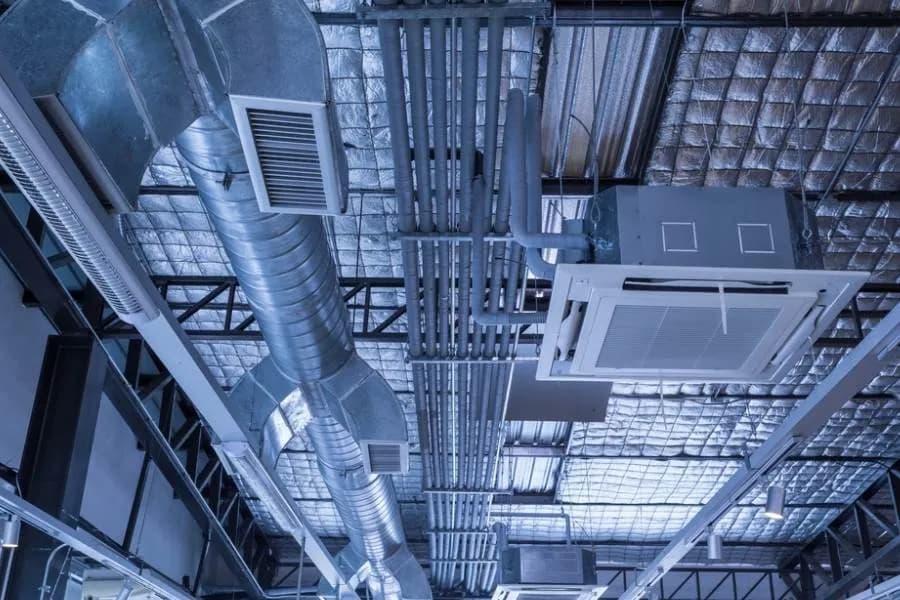
The system is pressurized and an aerosolized sealant is introduced into the moving air. Particles stay suspended until they reach an opening, where escaping air deposits them at the edges of the leak until it closes.
- Sealant carried to leaks by the airstream, not brushed on
- Leaks sealed from inside the duct without opening ceilings
- Duct interior surfaces stay clear of heavy buildup
- Buried, inaccessible, and above-ceiling runs sealed the same as open ones
Live Monitoring & Verification
Leakage is tracked on screen throughout the injection, so the crew watches the number fall in real time and stops when the system hits its target rather than guessing at coverage.
- Leakage rate graphed continuously during sealing
- Sealing stopped at the specified or agreed target
- Post-seal verification test on the completed system
- Remaining oversized leaks identified for manual repair

Reset, Report & Walkthrough
Blocking comes out, the system is restored and rebalanced where needed, and Hughes hands over a report showing the before and after leakage numbers for the building record.
- Removal of all temporary blocking and protection
- System restart and airflow confirmation
- Before-and-after leakage report issued
- Walkthrough with facilities or the homeowner

Want to Know What Your Ducts Are Losing?
Start with a duct leakage test. The number it returns tells you whether sealing is worth doing.
Measured, not estimated
The leakage rate is on screen the whole time the system is sealing. You are not taking anyone's word that the ducts are tighter now, and neither are we. The job ends when the number reaches target.
- Seals leaks inside ductwork that is buried, above hard ceilings, or otherwise unreachable
- No demolition of finished ceilings, walls, or soffits to reach seams by hand
- Leakage tracked live during the injection and stopped at the target rate
- Before-and-after numbers documented for commissioning, audits, or utility programs
- Works on new construction and on retrofits of existing systems
- Low-tack, water-based sealant deposits at leak edges rather than coating duct interiors
Commercial & Residential
Commercial Systems
Hughes runs the commercial Aeroseal equipment, sized for the duct volume and static pressure of full building systems. That is the work we are set up for and the work we do most: large systems, staged zone by zone where the run is too big to seal at once.
- Schools and university buildings
- Hospitals, clinics, and medical offices
- Hotels and multifamily high-rises
- Office buildings and tenant fit-outs
- Municipal and institutional facilities
- Light industrial and manufacturing space
Homes
The same process works on a house, and the symptoms are the ones homeowners already know: the bedroom over the garage that never warms up, a second floor that runs warm all summer, dust that returns a week after cleaning, and a system that runs longer than it should to hold a setpoint.
Most of a home's duct runs through attics, crawlspaces, and joist bays, which is exactly where hand-sealing is hardest and where air lost from a leak never reaches a room at all. Ask us whether your house is a good candidate.

Start with the number. Then decide.
A duct leakage test tells you what the system is losing today. If sealing is not worth doing, Hughes Sheet Metal will tell you that too.
Request a Duct Leakage Test→